


Highlighting
Our Community Impact
Our passion is equipping leaders to accelerate and better the region. Through the exemplary work of our graduates, the fingerprints of 3,500+ LPInc. Alumni are throughout the Southwestern Pennsylvania region and beyond.

Leadership and Learning in Action
We believe that when people do, they learn and when leaders give, they get. In recent years, our cohorts of senior leaders have worked with area nonprofit organizations to identify, develop, and execute on mission critical projects. In the last five years alone, nearly fifty Southwestern Pennsylvania organizations have had the benefit of servant leadership provided by program participants.
We are proud of the work of our participants, grateful to the partner organizations, and appreciate the ability to be able to help them serve their mission, while we serve ours of strengthening regional leadership through programs, partnerships, and connections.
Project Highlights
Our participants have actively contributed to community impact projects. Take a look at some of our featured projects:

LP
Spreading Love and Support: The Care Package Initiative
Host Organization:
Family House
Team’s Project/Purpose:
The Care Package Initiative for Family House brought joy, comfort, and a sense of belonging to the residents of Family House. Through the collective efforts of Leadership Pittsburgh XXXIX Peer Group 1 members, 150 care packages were thoughtfully assembled and delivered to the residents, providing them with essential items and heartfelt gestures of support. Family House’s mission is to provide a safe, comforting, and affordable “home away from home” for patients and their families who travel to Pittsburgh hospitals for expert medical care.
The primary objective of the Care Package Initiative was to supply Family House residents with essential items they needed during their stay. The care packages were curated to include practical necessities such as crossword puzzles, non-perishable snacks, and tokens of encouragement. Alongside the tangible items, the care packages provided emotional support and let the residents know that they valued while also fostering a sense of community among the residents and volunteers. The care packages became symbols of a larger community coming together to uplift and inspire the families residing at Family House.
The Care Package Initiative had a profound impact on the residents of Family House, lifting their spirits and providing them with a sense of comfort and encouragement.
Other Projects

Greater Pittsburgh Community Food Bank
A group from LP XXXIX spent a day volunteering at The Market at the Greater Pittsburgh Community Food Bank. Their volunteer time included assisting Market shoppers with item selection, checkout and bagging of their groceries. At the end of their shift, they also re-stocked shelves and prepared The Market for the next day’s shoppers.
Hello Neighbor
A group from LP XXXIX helped Hello Neighbor with setting up an apartment that was going to be the new home for a Rohingya family who was moving to Pittsburgh. The group transported necessary items from Hello Neighbor’s offices to the apartment. Upon arrival at the apartment, they met additional deliveries of furniture and supplies and proceeded to unload, unpack and setup all of the items needed to fully furnish the apartment and make it a welcoming home for the family.
LDI
Community Impact Projects
The Community Impact Project (CIP) is one of the many components of the Leadership Development Initiative (LDI) Program, which provides a real-world, hands-on opportunity for leadership skill practice and development.
This living, breathing “case-study” is undertaken by the group of high-performing and developing leaders in the LDI program each year, working together with a defined regional neighborhood’s stakeholders to deliver significant value to the host neighborhood, its people, and businesses.
The development, design, and execution of the CIP provides LDI participants from our region’s corporate, public, and nonprofit sectors opportunities to hone the skills and strategies taught throughout the program year while getting to know a neighborhood at a deep level and engaging civically.
The CIP was formerly known as PopUp Pittsburgh! occurred from 2009-2020 in various neighborhoods, including Uptown, Hilltop, Fineview, Lawrenceville, Mt. Washington, Larimer, California-Kirkbride, Wilkinsburg, Carrick, Millvale, McKees Rocks, and Sharpsburg.
City of Monongahela
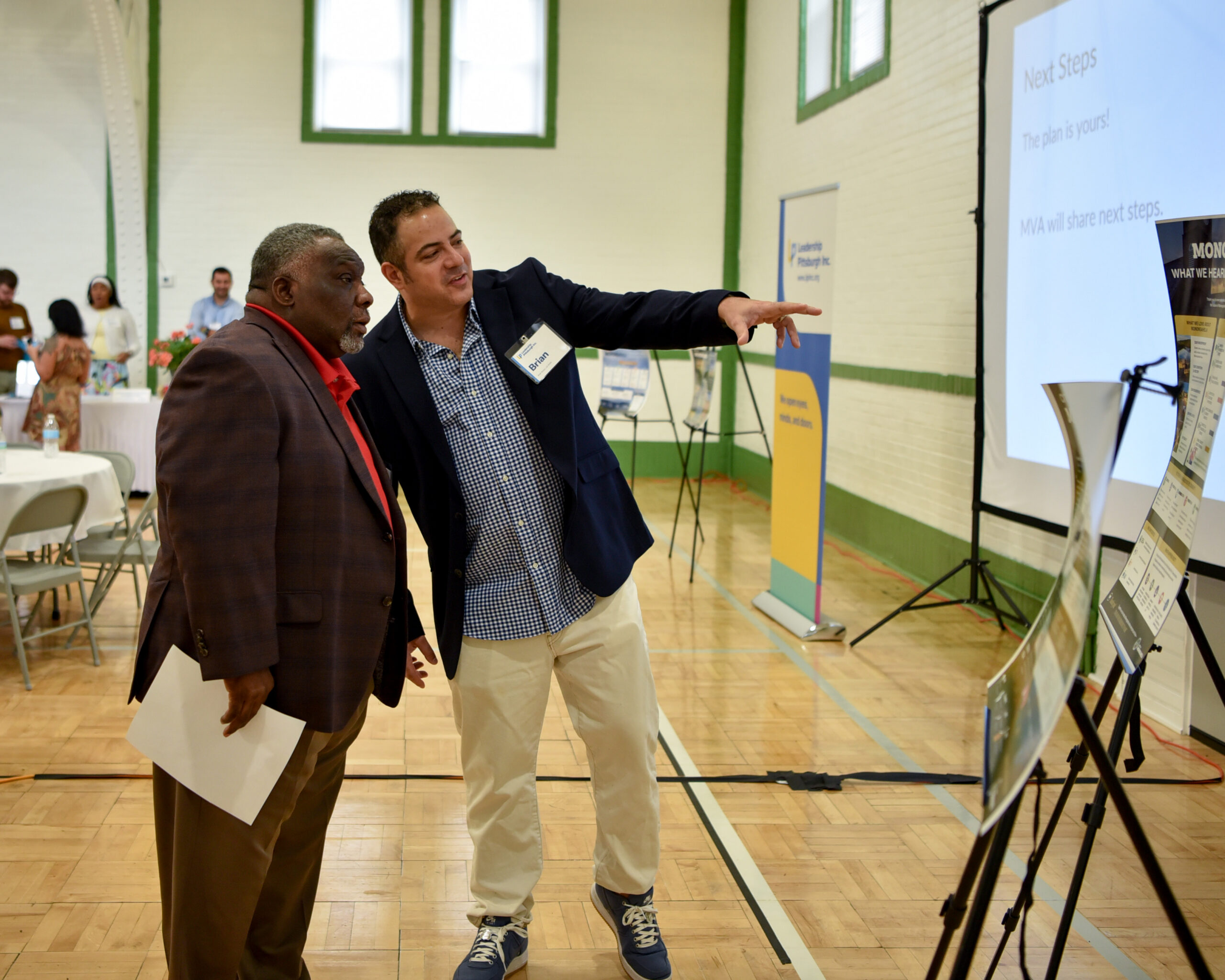
The LDI XXXIII cohort collaborated with the Mon Valley Alliance Foundation to develop a 5-year comprehensive, community-wide strategic plan for the City of Monongahela. Their work focused on the long-term revitalization of this important regional community in the areas of economic development, housing stability, quality of life, youth engagement, and regional collaboration. These findings will become the foundation of priorities that will guide future decisions, investments, and partnerships to build a stronger Monongahela.
Manchester – Chateau
The LDI XXXII cohort collaborated with the Manchester Citizens Corporation to explore the future of Pennsylvania State Route 65, focusing on how a transformation could impact Manchester-Chateau and the greater region. Their Community Impact Project work aimed to strengthen community connectivity by engaging stakeholders along the Route 65 corridor to ensure that any proposed changes consider regional mobility, economic impact, and quality of life.
Beaver Falls
The LDI XXXI cohort’s CIP took a regional approach by collaborating with the Beaver Falls CDC to engage community stakeholders in developing a comprehensive five-year strategic plan. This plan focused on five key areas, including Recreation, Housing, Education, Main Street Development, and Arts & Culture.
Allentown
The LDI XXX cohort worked alongside the Allentown CDC in the Allentown neighborhood, located in the City of Pittsburgh’s Central South Side. Their project aimed to engage community stakeholders by developing a plan to create civic pride amongst residents and businesses alike, better align community goals, and inform a strategy for a sustained financial future for the Allentown CDC.
Penn Hills
The LDI XXIX cohort worked with representatives from Penn Hills to better understand the needs of the community in relation to the Penn Hills Shopping Center, resulting in a comprehensive plan that currently serves as a playbook for future revitalization and redevelopment of the shopping center.
Enterprise Zone Corporation of Braddock
The LDI XXVII cohort worked with the Enterprise Zone Corporation of Braddock (EZCB) by engaging with the EZCB board, community leaders, businesses and residents of Braddock, North Braddock, Rankin and Swissvale to create resources that highlight the assets of the East Shore, that informed a short-term plan to attract positive attention to the area, and created “leave behind” resources that helped attract future growth and interest to the area.
CLCV
Beverly’s PGH
Beverly’s PGH celebrates and strengthens families by providing essential items and joyful experiences that meet needs, build connection, and spark lasting hope. This CLCV™ group project focused on increasing utilization of Beverly’s resources among military-affiliated individuals, including Veterans, Active Duty, Guard, and Reserve members. The team supported outreach efforts by providing input on intake forms to more clearly identify whether constituents had military service, distributing newly developed flyers both in person and electronically, initiating connections with employee resource groups to expand awareness, and providing input on future outreach opportunities that would specifically focus on military-affiliated families. These efforts were designed to strengthen outreach, improve identification of military-affiliated families, and increase awareness and access to Beverly’s resources.

Auberle
Auberle is an effective, innovative, holistic, and collaborative human service nonprofit that serves thousands of individuals and families each year. This CLCV™ group project focused on enhancing Auberle’s outdoor spaces to create a more welcoming, inviting, and home-like environment for residents. Through landscaping improvements, restored gathering spaces & walkways, and enhancements to the greenhouse & garden areas, the project created more intentional and cared-for outdoor spaces. The addition of raised planters provided residents with opportunities to grow vegetables and herbs, learn new skills, and take pride in caring for something over time. Beyond the immediate beautification, the project leaves Auberle with functional, sustainable spaces that residents can continue to enjoy, nurture, and grow for years to come.
HEARTH
A CLCV™ project group collaborated with HEARTH to help them achieve their mission of providing safe, affordable housing and personalized support to moms and kids rebuilding after homelessness and domestic violence. Through a combination of hands-on service and strategic support, the team contributed to both the organization’s daily operations and long-term capacity. All team members volunteered at childcare events, providing direct support to families, while also conducting a comprehensive review of HEARTH’s childcare volunteer training program and presenting recommendations to strengthen the training process. Beyond these efforts, the group helped coordinate the installation of a new chain-link fence along the playground with a local construction company and assisted with relocating a shed and bicycles on the property. At the end of their project, the group planned to continue to be involved in volunteer efforts at HEARTH.